


The university has various offices, commissions, and committees that have a more or less direct impact on your current and future studies. Here we present an overview of the most important bodies, offices, and their responsibilities.
Physics Faculty
Faculty's Student Council (Fachschaftsrat, FSR)
That's us!
Just like the StuRa, the FSR is part of the organized student body at the university, so our official duties are determined by the⇱§ 25 Sächsisches Hochschulgesetz (Saxon Higher Education Act) The student council is the direct link between students and university policy. It represents the students of the department (i.e., Bachelor and Master Physics, Master OME, and Physics Teaching students) in several committees and ensures the flow of information in both directions.
The elected members of the FSR are directly elected by the students of the Physics Faculty for a term of one year. The elected members decide on financial requests and other important matters by majority vote. They also send representatives to the StuRa, study commissions, examination boards, faculty council, ZaPF, and other committees. To be sent to some committees, you must also be an elected FSR member yourself. However, many decisions are made based on "opinion polls", in which you can participate even if you are not a member or an associate (unelected) member. Most decisions are made in the weekly FSR assembly. The assembly itself is open for all, and its protocols are made publically available afterwards.
More infos: ⇱https://www.pfsr.de/allgemeine-informationen/
Faculty Council (Fakultätsrat, FakRat)
The Faculty Council is the highest body of the faculty.
The Faculty Council is chaired by the Dean. The Physics Student Council provides three student members, joined by nine professors, the Equal Opportunities Officer, and four members from the academic, technical, and administrative staff. The current composition can be found ⇱here.
The Faculty Council is responsible for all staffing and recruitment policies as well as doctoral programs.
Faculty Equal Opportunities Officer (Gleichstellungsbeauftragte/r)
Equality officers are present at several levels of the university. Students can also run for this office at the faculty and department level and vote for candidates accordingly. Equality officers are automatically members of the faculty or department council. They serve as contact persons for problems and questions in the area of equal opportunities, i.e., anti-discrimination, compatibility of work/study with family/care, inclusion of gender and diversity-related aspects in research and teaching, and balanced gender distribution in leadership positions. Furthermore, they support related projects and events.
Examination comittee
The Audit Committee meets only when necessary. The need always exists when problems arise that affect exams. This is the case when procedures have to be rearranged, you make a request for a special arrangement (e.g. you want to take another minor subject) or you feel that you have been treated unfairly during the examination. In the latter case, of course, you should always talk to the persons concerned first. That is, talk to the examiner, the assessor or possibly the examination office. Only if no agreement is foreseeable will the examination board be convened and a decision made on the basis of the examination regulations. To ensure that the student perspective is also represented, student representatives are sent by the FSR.
Fortunately, the exams in physics are very fair, so that the examination board rarely has to meet. Nevertheless, please do not hesitate to contact us in case of difficulties or inconsistencies!
There are three exam comitees for Bachelor, Master and teacher training.
Study comitee (Studienkomission) (StuKo)
The study commissions take care of the smooth running of your studies. That is, they deal with all matters of teaching and study organization.
Currently, there are three physics degree programs at TU Dresden (not including the Master's in Organic and Molecular Electronics): Bachelor's, Master's, and teaching (state examination). The study committees for teaching are interdisciplinary and based at the ZLSB. Physics has its own informal “Expert Committee for Teaching.”
The study commissions create, revise, and improve the study regulations for the respective degree programs. They also deal with current issues in teaching.
Your student representatives on the study committees are always open to suggestions from you. If you have any ideas on how to improve modules or exams, or if you encounter any problems, we will be happy to help. We also welcome your feedback on how your studies are going. Please feel free to contact a member of the student council whom you trust.
An overview of the members of the study commission can be found at ⇱Members.
The work of the study commission is accompanied by the two study program coordinators, to whom one can also turn with more personal problems of study organization.
Lab course comission
The Lab Course Committee is concerned with improving physics lab courses for bachelor's and teacher training programs, as well as for physics as a minor subject (e.g., for medical and chemistry students). Currently (2025), for example, a new assessment method is being tested in the minor subject lab courses, which may be expanded later. Members of the Lab Courses Committee are the (deputy) heads of the internship, several professors/research assistants, and two student representatives sent by the FSR.
School of Science (Bereich Mathematik und Naturwissenschaften)
School Comittee
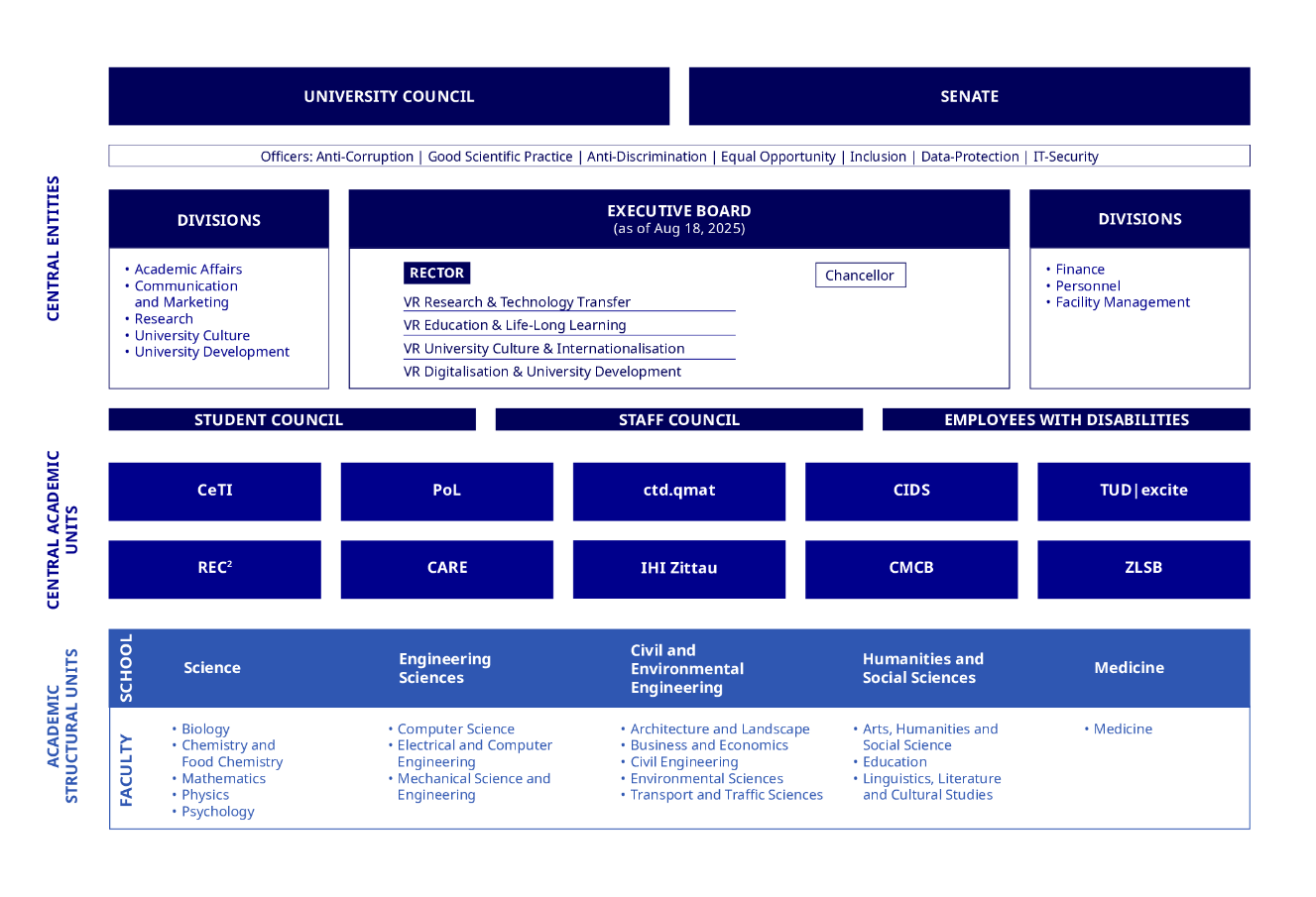
The faculties at the TU are organized into five schools. Together with mathematics, computer science, chemistry, biology, and psychology, the Faculty of Physics forms the School of Science.
The school comittee is roughly equivalent to the faculty council for the school. Representatives of all member groups also have seats on the school comittee, including a directly elected student member from physics. However, since the faculties are relatively independent, funds are distributed much less frequently in the school comittee, and decisions relevant in the short to medium term are made less often.
School Equal Opportunities Officer
Equality officers are present at several levels of the university. Students can also run for this office at the faculty and department level and vote for candidates accordingly. Equality officers are automatically members of the faculty or department council. They serve as contact persons for problems and questions in the area of equal opportunities, i.e., anti-discrimination, compatibility of work/study with family/care, inclusion of gender and diversity-related aspects in research and teaching, and balanced gender distribution in leadership positions. Furthermore, they support related projects and events.
University-wide
Rector's Office and Rector
The Rectorate consists of the Chancellor and four Vice-Rectors and is headed by the Rector. It is the highest authority at the university.

The rector is elected for five years by the Extended Senate, so Ursula Staudinger (pictured) is expected to continue to bear the burden of the chain of office until 2030. The rector exercises domiciliary rights and can make decisions in urgent matters in place of the bodies actually responsible. She represents the university externally and decides on its strategic direction.
The vice-rectors represent the rector and are appointed by her. There are currently four vice-rectors for digitalization and university development, university culture and internationalization (a first in Germany), education, and research.
The chancellor manages the university's administration and budget and is appointed by the Saxon State Ministry of Science, Culture, and Tourism.
Senate and Extended Senate
The Senate is the highest body of academic self-government.
It decides everything fundamental, such as study regulations, and university-wide, such as the distribution of budget funds. It consists of representatives of the individual status groups:
- 11 Professors
- 4 scientific employees
- 2 other employees
- 4 students
The student senators are directly elected by all students at the university for a term of one year. The other members are elected for a term of five years by the respective status groups according to the so-called constituency system.
In order to cope with the large number of tasks, the Senate forms commissions in which work and resolution proposals are prepared. The members of the senate commissions are appointed by the senate and do not have to be members of the senate.
The are 4 Senatskommissionen:
- Senate commission Teaching
- Senate Commission on Budget, Structure and Planning
- Senate Commission on Equality and Diversity Management
- Senate commission Research and early career
Responsible for amendments to the Basic Regulations of the TU Dresden, as well as the election of the Rector, is the Extended senate . This is composed of the members of the Senate and following additional members:
- 11 Professors
- 4 scientific employees
- 3 other employees
- 4 students
more infos at ⇱https://tu-dresden.de/tu-dresden/organisation/gremien-und-beauftragte/senat-senatskommissionen
Students council (StuRa)
The Student Council of TU Dresden – StuRa for short – is a committee made up of representatives from the individual student councils of the faculties (and the managing directors of the StuRa). Since the physics student council is one of the smaller ones at the university, it normally sends exactly one representative to the StuRa. In particular, this representative must attend the StuRa meetings and report back to the student council.
The StuRa represents the student body and thus the interests of the students. This includes communication with the university, politics and of course the student councils, but also the concerns and applications of students, groups and student councils that are presented to the StuRa. Furthermore, the Stura negotiates about the ⇱semester fee and decides on the distribution of funds from the share allocated to the student body.
In addition, the StuRa offers numerous services on site, such as counseling for studies, BAföG, and much more. You can find everything else on the StuRa homepage: ⇱https://www.stura.tu-dresden.de/
University elections
University elections take place once a year at the end of November/beginning of December. There you can elect a large number of representatives for the following committees and offices:
- Faculty student council (and thus indirectly StuRa, etc.)
- Faculty council and school comittee
- Senate and Extended Senate (and thus indirectly the Rector)
- (Deputy) Equal Opportunities Officer for faculty and school
The election is currently taking place largely in person, but you can also apply for a postal vote in advance.
The student representatives for the Senate and Extended Senate form several electoral lists, some of which have different goals and ideas. The electoral system is designed to favor small lists, which is why groups aiming for more than one seat often draw up several lists. It is best to research the candidates in advance.
More information about the current election is available from the StuRa at: ⇱https://www.stura.tu-dresden.de/wahlen